The Design of Things

human endeavor + the natural world

copenhagen ii: to ride a bike

SnowyBiking

Riding a bike at a UN climate conference can be more visionary than the talks themselves…

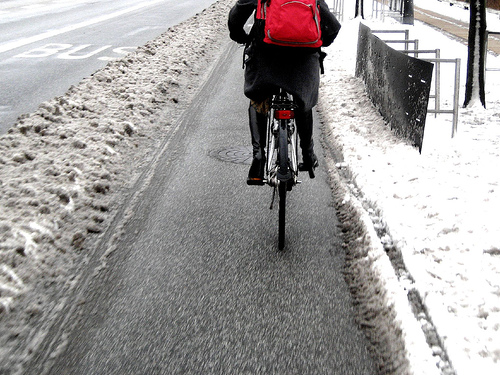
To get on a bike in Copenhagen is to enter into the stream of Denmark. You sit tall on a sturdy machine, equipped with fat tires and fenders, scarf around your face, hat on your head, boots covering your legs. You can ride, as I did, in a skirt or a suit under your coat and be dressed for work when you arrive. As one bike lane gives way to another, you are traffic itself, not peripheral to it. The bikes proceed as deliberately as automobiles. The bike lanes are delineated by concrete infrastructure – curbs or even parking areas between them and the cars.

I got on a bike in Copenhagen because it was my only means of transportation to the Bella Centre, the site of the UN climate talks in December, 2009. Protests around the talks had become violent, shutting down passage by train or taxi, but I had to bring my NGO pass to my colleagues.

The Bella Centre was built outside of the old city, on the flat former fields that support convention centers, hotels, and high rise apartments everywhere. Even design-conscious Scandinavia sports this cheap twentieth-century landscape. Yet here these wastelands -usually the sole province of automobiles – are made accessible and convenient by bike.

Biking there was not an athletic, scenic, or political act. It was utilitarian, a likely means of transportation no matter what the weather, the size of the road, or the density of the traffic. When I entered the bike lane outside my hotel, the streets were wet and cold and I wasn’t sure where I was going exactly. I was immediately swept along in the bike traffic, unable to easily stop or turn around without being run over. We crossed a bridge to the southwest of the city center to a minor highway split down the middle by the train track. The sun, already beginning to set at two p.m., was a vague smear of light over fields and small neighborhoods.

We crossed over a major highway. A windmill turned and farther out on the horizon stood smokestacks. Snowflakes flew. As I neared the Bella Center, the auto traffic stood still under beating helicopters. Giant sculptures of three Masaai rose out of the yellow grass as some sort of display for the talks. They had the emaciated, haunted look of the skeleton sculptures that protest groups had put near the doors of the convention center in somebody’s idea of inspiration.

At a UN checkpoint I saw how much I’d managed to assimilate just by biking. One of the officers approached, smiling, and addressed me enthusiastically. Maybe he was remarking on the craziness all around; I had no idea. I didn’t even know how to say “I don’t speak Danish” in Danish. I stopped, shrugged my shoulders, and laughed, pulling the pass hanging around my neck out from under my scarf. His eyes widened in surprise at a foreigner on a bike.

The people who had come from all over the world to negotiate reducing greenhouse gas emissions were stuck in traffic. Those who came to protest were behaving such that helicopters and SUVs had to be brought in and run all day. Seemingly unaware of it, they presented the world that is: noisy, clashing, exhausting of resources, inefficient. The world that causes climate change.

I continued on past the Convention Center to the Radisson, where NGOs and negotiators had decamped while waiting for their passes. I wheeled the bike up a narrow ramp etched in the concrete beside the front steps for just that purpose, parked it with the many others in the rack, took off my coat to reveal my work outfit, and went inside.

What I had just experienced was part of the vision and the infrastructure of the carbon-light world. The people around me huddled with their Blackberries while the protesters outside delighted in made-for-TV clashes with the police. But getting on a bike, within a city- and nation-wide infrastructure that made this a mainstream and convenient option, was the least act of protest and the most visionary. It was an example of structure and change we might implement to save ourselves. Nobody mentioned that.
BicyclistinCopenhagen

copenhagen I: design for solstice

Image

Now that the Christmas season is upon us, just as we’ve given thanks, we’re being pressured to think about black days and cyber sales, and things and money and taxes. I am thinking instead of Copenhagen three Decembers ago, when my husband and I encountered a real solstice, in one of the darkest and coldest cities on the planet, realized by just a few design and lifestyle choices there.

Though I love winter, I can get bleakly sad at its start. Around 5:00 p.m. in November and December I want electricity and lots of it. I want light and warmth. I want noise and companionship. I want to turn on every light in the house, turn up the thermostat, and turn on the television and my computer and maybe the radio too.

This leads, of course, to the shopping. Stores are well lit; the car has music and heat, and gathering things for solace seems a way to cope with the winter.

Except that it’s not. As we all well know. Magazines telling us how to “manage” the season and “step off” the treadmill of holiday crazy aren’t addressing the real problem: that we feel the need to escape the sudden descent of cold and dark onto our lives. Like everyone else, by the time Christmas is over I’ve always felt I somehow missed the joys of the season. Until I found Copenhagen.

It seemed a quiet and not especially pretty city at first. Emerging from the central train station, we first saw the brick walls around Tivoli, an old-fashioned amusement park and winter village that was billed as magical but to me looked Hans Christian Andersen-sad and cindery in the already fading grey light.

After taking a nap and waking in a haze of jet lag to complete darkness at 3 p.m., I could feel depression coming on. Dark at 3 p.m.? We ventured outside to see how they handled it.

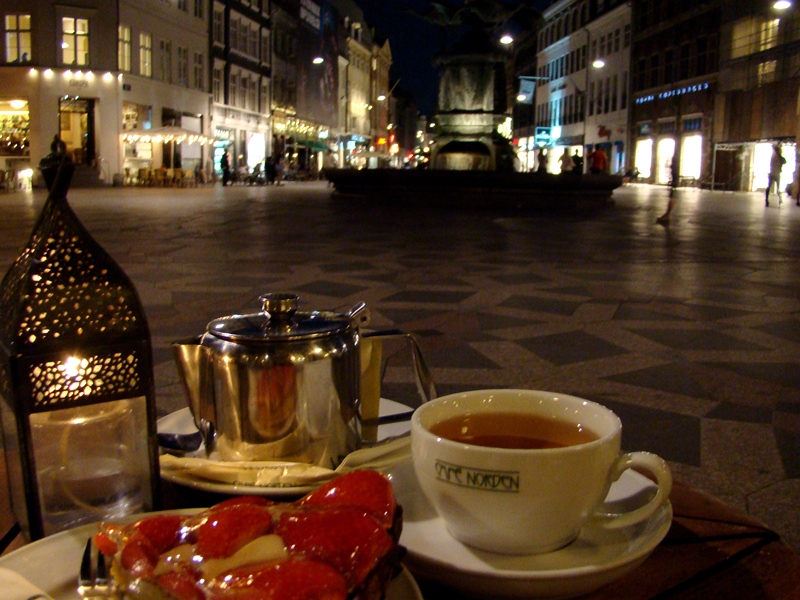
They celebrate it. Candles are everywhere, lit all day long. From our unremarkable hotel lobby to the many cafes and restaurants, the flickering light eases the abruptness of early nightfall. Grownups drink hot cocoa, stopping for it at midday, and around 4 move to glügg (spiced hot wine) because yes, alcohol is involved in the wintry feeling.

Department stores were not filled to the brim, overflowing in a way that causes grabby anxiety and makes you either spend more than you wanted to or leave in despair. Instead they were set nicely with individual items. This was, after all, Denmark, design capital of the world. The George Jensen candlesticks just look good by themselves. But there were lower priced stores too, with $6 games and toys and even a kind of dollar store with Danish Christmas stuff in the walk-able part of the city.

Every decoration referenced the reality of the season: bare spruce wreaths hung by twine in a hip café with red and white wallpaper adorning one wall against stainless steel and wood, pine cones in bowls, small trees at doorways, paper stars and hearts strung across windows. Silver candlesticks and glass votives. Very little glitter and yet so much warmth and reflection.

Most striking was that people were outside like it was summer, many of them riding bikes. They weren’t wrapped in highlighter yellow nylon, either, but wore overcoats and scarves, skirts or trousers while they commuted or picked up groceries or kids.

For the first time winter solstice became a reality –  a chance to embrace the shorter days, make an excuse to have a hot drink or a cold walk, reflect on bareness and naturalness and light and dark.

At home, Copenhagen has seeped in to my approach to this time of year. I’ve realized I must get outside, even after dark, and this requires a sharp and warm winter coat I’m glad to throw on. On the Saturday after Thanksgiving, my husband and I bundled up, put computers in our backpacks, and rode our bikes through a bracing wind to a Peet’s Coffee the next town over, worked there for awhile over cups of “winter spice” tea, then rode home, lit candles, and ate dinner in the living room.

All this outdoorsiness and calm has led to my inadvertently joining the “go local” movement, discovering or rediscovering stores not overflowing with junk made in China but where the owners have done some of the selecting for me. I’ve picked out things I’m excited about made of nice materials at good prices. Not China prices, but good enough to feel good about gift-buying again.

This year I thought about how to make my house feel warmer without using more energy. I looked at the downstairs windows and realized they become big black holes at 4:30, sending me rushing to the thermostat. I bought creamy white shades to both hide the black and reflect the lamplight more warmly, cheering the rooms.

I don’t need every light on anymore. I’m not panicking or freezing. I do still want to watch movies more than I do in July, but that’s okay.

I’m relaxed enough that this year I’m throwing a party on the solstice itself to celebrate the longest night of the year and kick off Christmas. There will be glügg.

restoration hardwood

Image

In 1998, I remember looking out my office window and seeing a woman trying to get out of her car, clutching an enormous drink, wearing an enormous parka, tumbling out of an SUV that was too big for her. My mind flashed to all the other oversized items cluttering up our lives – like giant candles with seven wicks from Pottery Barn – and thought, “We’re going to look back on this time and think…‘big’.”

It was the heyday of no limits, presided over by President Bill with his cheeseburgers and his outsized appetite for “is”-ness. The Rainforest Action Network was turning us on to forests through caramelized nuts, leading us to believe we could save them by eating candy. The stock market banged along taking us all with it crazily upward – just grab a leaf on the vine, whichever one makes sense to you! Starbucks! Microsoft! ExxonMobil!

That flying high lasted another ten years until the whole debt-laden tower fell with a crash. We’re still climbing out of the rubble. The Asian rainforests, as predicted in 1998, are largely gone, replaced by plantations to fuel our thirst for hardwood and palm oil. McMansion production has stopped, with 40 million of those homes (the destination of much of the rainforest wood) standing empty after foreclosure. The carbon from those forests has now irretrievably been added to the atmosphere.

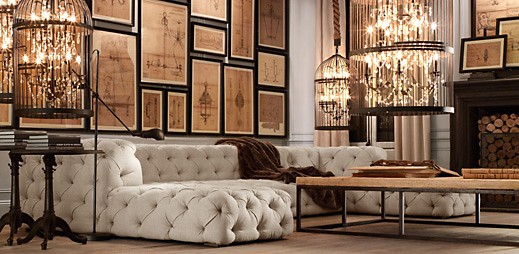
Enter the Restoration Hardware catalog, relaunched last year amid the Great Global Bubble Burst. A company that used to offer Mission furniture with witty accessories, the new RH is full-on romance, blazing forward with a “limits be damned!” gigantic attitude. The new CEO looks like a Ralph Lauren model who takes himself very, very seriously. His letter opens the door to 654 pages of distressed wood and linen neutrals all shaped to remind us of various eras of the past. The references are slightly unclear: Amelia Earhart biopic with some Midnight in Paris thrown in, a little Gatsby, perhaps? The English Patient, complete with leather-covered cigar case dressers? I’m not sure. But all of these are presented as imagined and rebuilt on a Universal Studios set because, as the dresses and gloves from my great Aunt Agnes tell me, things (and people) were much, much smaller back then.

The 188 inch sofas, the ceiling fans that look like they are from the front of a prop plane (though possibly bigger than the ones Roald Dahl flew for the RAF), the $3000 3 foot birdcage chandeliers, and the tall hooded armchairs that might have a tiny vial propped in the middle for Alice, labeled “EAT ME”, all scream big is best.

The catalog seems to hope we are sitting in McMansions trying to find the perfect 15 foot sofa just before the house is, in the parlance of easy money, “flipped”. It seems to think there is no reason, no reason whatsoever, to eschew the excesses of the past.

Instead, it suggests we can repent with nods to naturalness, such as using colorless rough linens and making the furniture from plantations where rain forests once stood. Or from salvaged wood, or just from wood meant to look salvaged.

This no-limits nostalgia leaves the whole 654 page package somehow not all that interesting.  Make the catalog heavy enough to give the mail carrier bursitis? Fill it with furniture that could break your foot? That doesn’t translate to real sophistication.

The historic reference that’s missing is to the last ten years – the need to do more with less, to scale down while bringing quality up, to add wit to indulgent whimsy.

The overarching reference – revealed in the French Empire section of the children’s catalog – is to Versailles. The Louis XIV chairs clothed in pale linen look like the ghosts of opulence.

dials, caps, and folded-up triangles

Sometimes the best design is so simple we never even notice it. The cap on the toothpaste – a slim threaded screw top. A piece of waxed cardboard folded up to become a carton for milk. A dial that turns.

Our Toyota Prius has a touch screen for all the interior controls, requiring the driver to take her eyes off the road to adjust anything. The screen is set high and is fully lit, so the white-green light is a constant glare against the black of a nighttime highway.

The Volkswagen has dials, lit quietly in red and blue circles, sitting low and within easy reach of the right hand. Everybody knows that dials mean yesterday. I don’t mean to stand in the way of progress, but the dial is a design that cooperates beautifully with the supercomputer that is the human brain. Fire up muscle memory and all you have to do is reach over, without looking, and turn up the heat or change the tunes.

The tube of toothpaste in our house right now has a “family style” top that attaches to the tube and clamps over the end. It is much bigger than a toothpaste cap. It never really closes, particularly after any toothpaste has been squeezed out and a little bit lingers on the end. It makes a mess of toothpaste where it sits, and it’s made from at least twice the plastic of a simple cap.

Many milk cartons now feature a round hole with a plastic cap on the side for pouring. When bakers want to be precise, they create a paper triangle from which to measure out flour. When you pour from a round hole you might pour more, or you might pour the same, but do you need the extra plastic? Apparently, if you have children (say the advertisers) you do.

All the extra plastic waste turns to tiny beads that are often ingested by marine life, like dolphins and whales. The constant light of screens not only takes our eyes off the road, but messes with our brains and our endocrine systems, hopping us up and dropping our levels of the cancer-fighting hormone melatonin.

Not to mention all that toothpaste lost to American sinks.

It’s enough to make you appreciate the beauty of a dial, a small threaded cap, and a folded up waxed paper triangle – still available, if you can find them, in a showroom or grocery store near you.

outside in

“The palace is a palace, a brick building. It’s not where the magic is,” Renzo Piano on the Isabella Stewart Gardner museum.

The Isabella Stewart Gardner Museum is a rich woman’s palace built in 1901 to house her expansive art collection and share it with visitors from all over the world. Dark and dreary, encrusted with religious art and cathedral relics and cases filled with revolutionary autographs, the house has always been a favorite stop in Boston.

Despite the millions and the masters on the walls, however, the chatter is always about the courtyard. The light, floating greenhouse in the center of the palatial gloom.

“Oh, you’ll love it!” everyone says, after mentioning the art. “It has the most wonderful courtyard.”

We are admiring of buildings – or even rooms – that bring the outside in, whether we realize it or not. Our senses recognize the feeling of expansion even before our eye can see it. Our bodies and minds respond to air and to natural light.

The architect Renzo Piano transformed Isabella’s palace by extending her secret courtyard to the outside with the addition of a soaring glass structure that houses a “living room” complete with shelves of design books and comfortable egg chairs, a café, a concert hall, and, of course, a greenhouse.  Everywhere you sit, you are surrounded by glass, by green, by the city. You are no longer simply visiting a museum but comfortably sitting in the landscape.

There is a gift shop, but the appeal of the building and its surroundings is not stuff. It’s doing, being, seeing, borrowing, reading, thinking, relaxing, eating, reflecting. Living. It’s a great place to go to live for a few hours.

Just what our homes should be, and often aren’t. We can’t change (usually) the architecture of our homes and offices but we can invite the light. We can open our floor plans to windows, making it possible to sit by them, work by their light, feel the passage of the sun and shadows or hear the rain throughout the day.

I worked in three boxes in Washington, D.C. but in each one I had a window around which I oriented my workspace. I live in an old Victorian that was stuffed to the gills with furniture before I moved in so that I did not see the windows, and beyond them, the outside.

Turn your desk to the light. Move an armchair by the bay. Angle the sofa so even if you can look at the television you’re close enough to the sash to feel the breeze and hear the birds and look over the lawn or out at the treetops.